
Join the Weather Lovers Community at Skool

Most of us see clouds every day, but only very occasionally will you be lucky enough to spot one of these 7 particularly rare types – some of which can only be seen in very specific circumstances or locations. But what is the rarest cloud type?
Noctilucent clouds
Noctilucent Clouds are one of the rarest and most beautiful of all cloud types. They are found at very high altitudes – up to around 250,000 feet Visible on clear, summers nights between 45 °N and 80°N latitude ,they appear illuminated by a blue or occasionally red or green light. We still do not know much about how they are formed, but they are thought to be made up of ice crystals.
Kelvin-Helmholtz clouds
They can sometimes be seen as far as 60 miles downwind of the mountains that formed them. An extremely rare phenomenon, where clouds form as a billowing wave pattern Occurs when there is a strong vertical shear between two air streams. This causes some winds to blow faster at the upper level, than at the lower level.
Mammatus clouds
Bulge or pouch shaped, Mammatus Clouds are usually seen emerging from the anvil at the top of cumulonimbus clouds. Formed by turbulence, they are one of the few clouds that come from sinking, rather than rising air.
Lenticular clouds
Usually formed behind hills or mountains, where the air is stable and winds are blowing from a similar direction. These tall geographic features interrupt the wind, the airflow undulates and condenses into these disc shaped clouds.
Funnel clouds
Cone shaped clouds which extend from the cloud base, but never actually touch the ground. Formed in the same way as a tornado around a small area of intensely low pressure. If a funnel cloud reaches the land it becomes a fully fledged tornado and if the funnel cloud reaches the surface of a body of water, it becomes a waterspout.
Fallstreak Hole clouds
Also known as a hole punch cloud – they form when part of the cloud layer turns to ice crystals which are large enough to fall. Water droplets in the cloud, cooled below 0°C but not yet frozen, will freeze if they find a particle to freeze on to or are cooled to below -40°C. Aircraft can cause this to happen by making the air expand & cool as it passes through the cloud
Arcus cloud
Formed when warm air within a storm cloud is pushed up from the ground by the cold air exiting downwards. Unattached to the storm cloud they are known as roll clouds, but when attached they are called shelf clouds.
Latest Cloud Posts
- May 2023 Weather in Durham – Cool and showery at times
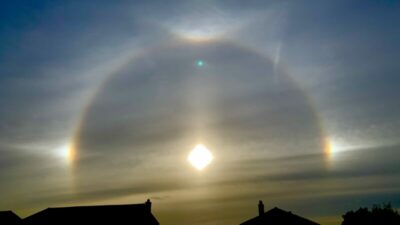 Join the Weather Lovers Community at Skool May 2023 starts in showery mood May 2023 started in a showery mood on 1st, with heavy rain and a sharp drop in …
 - Mammatus Cloud in Durham on 6th February 2022
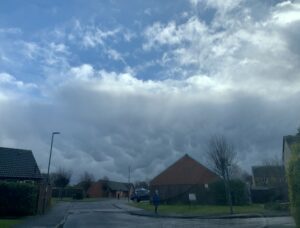 Join the Weather Lovers Community at Skool The following was observed just after the passage of a very potent shower on 6th February 2022. The ‘cows udder’ appearance of Mammatus …
 - Tornado (Funnel Cloud) over Darlington 10th July 2021
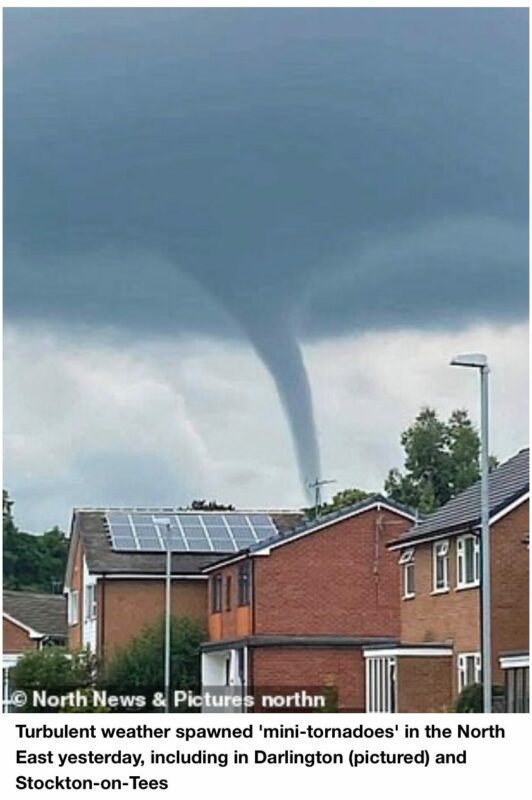 Join the Weather Lovers Community at Skool There was a lot of hot but turbulent weather early in July 2021 which spawned some thunderstorms and funnel clouds in places. Funnel …
 - 7 Rare clouds types | Amazing Weather
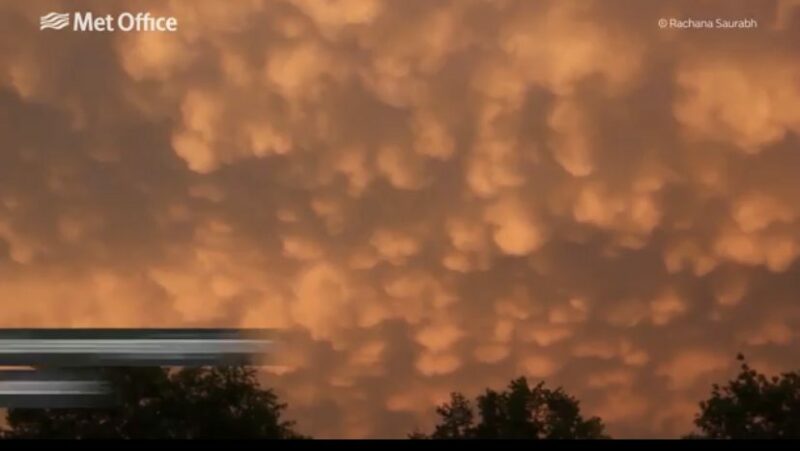 Join the Weather Lovers Community at Skool Most of us see clouds every day, but only very occasionally will you be lucky enough to spot one of these 7 particularly …
 - Noctilucent Cloud Display over Durham June 2019
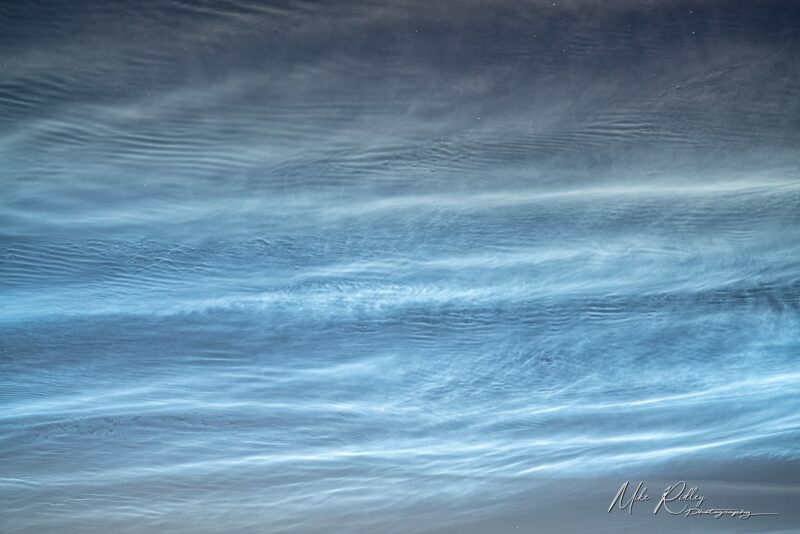 Join the Weather Lovers Community at Skool Noctilucent Clouds over Durham City, June 17th/18th 2019 by Mike Ridley Photography Some of you eagle-eyed skywatchers will have noticed a ghostly glow …
 - Funnel Cloud seen over North East England – 28th May 2019
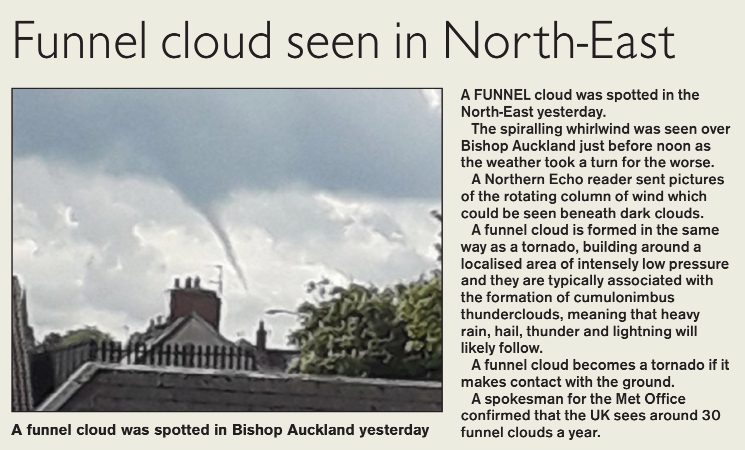 Join the Weather Lovers Community at Skool The report above appeared in the Northern Echo newspaper on 29th May 2019. The axis of funnel clouds may be vertical, inclined (as …
Join the Weather Lovers Community at Skool